Union Minister Jitendra Singh claimed India has entered an era of ‘Clean, Green Highways’ with bio-bitumen technology transfer.
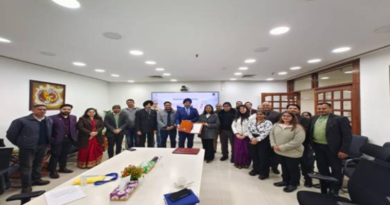
Photo Credit: PIB
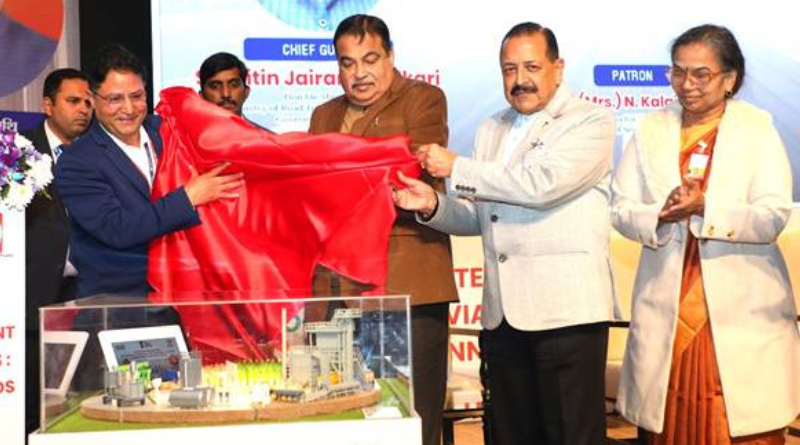
New Delhi, January 7, 2026: Union Minister of State for Science & Technology, Earth Sciences, and Vice-President of CSIR, Dr. Jitendra Singh, on Wednesday said that India has entered a historic new era of “Clean, Green Highways” with the successful technology transfer of “Bio-Bitumen via Pyrolysis: from farm residue to roads.”
Addressing the technology transfer ceremony, Jitendra Singh said the indigenous innovation, jointly developed by CSIR—Central Road Research Institute (CSIR-CRRI), New Delhi, and CSIR—Indian Institute of Petroleum (CSIR-IIP), Dehradun, would be remembered as a major milestone in India’s infrastructure journey.
“This day will go down in history as India transitions from fossil-fuel dependency to bio-driven, regenerative and circular economy solutions for its highways,” the Minister said.
Jitendra Singh added that roads constructed using bio-bitumen would involve lower costs, longer sustainability, and significantly reduced environmental pollution.
Jitendra Singh said the initiative is a step toward Vikshit Bharat:
Jitendra Singh described the initiative as a whole-of-science, whole-of-government and whole-of-society effort, embodying the whole-of-nation approach envisioned by Prime Minister Narendra Modi for building a Viksit Bharat.
He said innovations such as bio-bitumen demonstrate how scientific research can directly support national missions like Swachh Bharat, Atmanirbhar Bharat, and economic self-reliance.
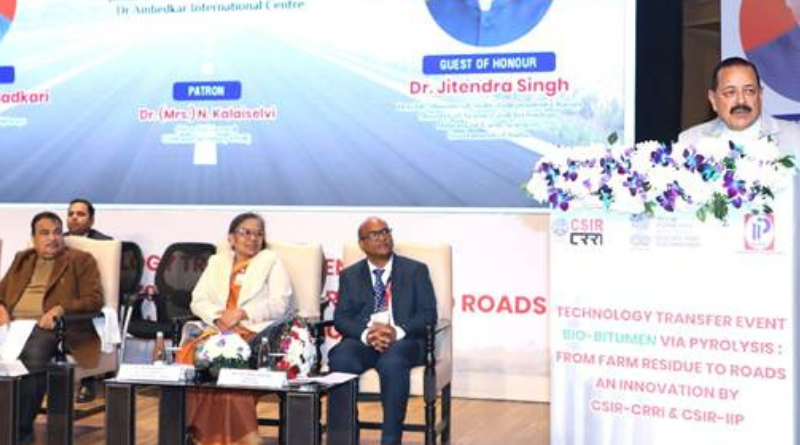
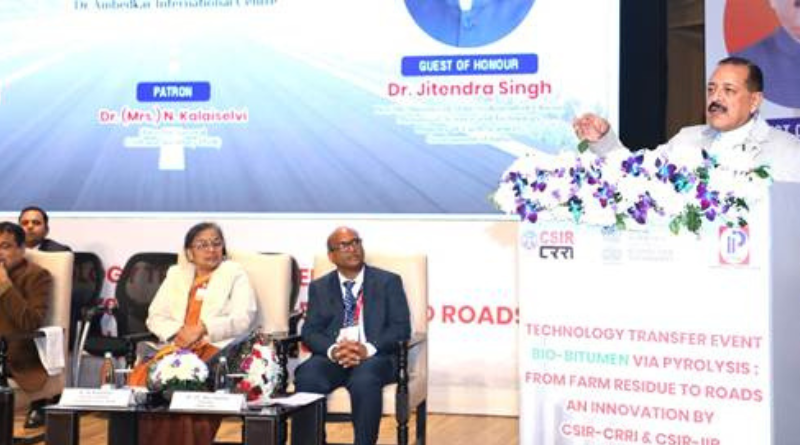
Emphasizing the importance of outreach, the Minister said that scientific innovations must be communicated in a way that enables wider stakeholder understanding, acceptance, and adoption.
He noted that over the past decade, CSIR has focused on opening science to citizens, industries, and state governments.
Highlighting the waste-to-wealth dimension of the technology, Jitendra Singh said Bio-bitumen addresses multiple challenges simultaneously—stubble management, environmental protection, and reduction of imports.
Bio-Bitumen will reduce foreign dependency:
He pointed out that India currently imports nearly 50 percent of its bitumen requirement, and large-scale adoption of bio-bitumen could significantly reduce foreign dependence while strengthening domestic capabilities.
He also underlined the economic potential of replacing imported bitumen worth Rs 25,000-30,000 crore annually.
The event showcased the industrial-scale technology transfer of bio-bitumen produced through the pyrolysis of farm residue.
The process involves the collection of post-harvest rice straw, pelletisation, pyrolysis to generate bio-oil, and blending with conventional bitumen.
Extensive laboratory validation has demonstrated that 20-30 percent of conventional bitumen can be safely replaced without compromising performance.
The technology has undergone comprehensive physical, rheological. Chemical and mechanical testing, including assessments for rutting, moisture damage, and resilient modulus.
A 100-metre trial stretch using bio-bitumen has already been successfully laid on the Jorabat-Shillong Expressway (NH-40) in Meghalaya, confirming its field-level feasibility.
A patent has been filed, and multiple industries have been onboarded for commercial deployment.
Drawing from his experience with alternative materials such as steel slag, waste plastic, and bio-fuels in road construction, Singh said successful scale-up depends on the convergence of proven technology, economic viability, raw material availability, and market readiness.
Jitendra Singh assured full institutional support for integrating bio-bitumen into national highway standards.
Director General, CSIR and Secretary DSIR, Dr N Kalaiselvi, termed the occasion a proud moment for Indian science, noting that India has become the first country in the world to take bio-bitumen technology to an industrial and commercial scale within the same year.
She explained that biomass pyrolysis bio-binders for roads, energy-efficient gaseous fuel, bio-pesticide fractions, and high-grade carbon suitable for batteries, water purification, and advanced materials—making the process emission-free, cost-effective, and future-ready.
She also proposed policy-level blending mandates to enable nationwide adoption.
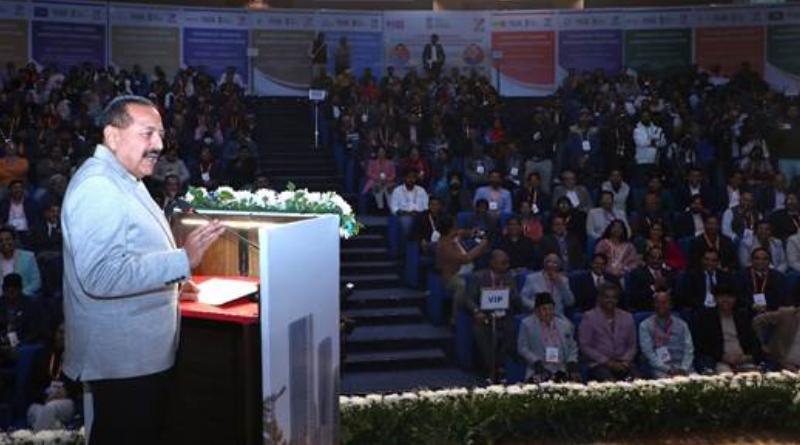
The event was attended by senior leadership from CSIR-CRRI and CSIR-IIP, former directors, scientists, industry partners, and media representatives, reflecting a strong partnership between science, government, and industry.
The technology transfer reaffirmed India’s commitment to sustainable infrastructure, indigenous innovation, and a bio-driven economic future, firmly placing the nation on the path toward clean, green and self-reliant highways.
Also Read: Great infra boost: Nitin Gadkari announced to build Bihar similar to the USA in 4 years.
EOM.


Pingback: Dr. Jitendra Singh emphasized that the Andaman & Nicobar Islands need to be developed as a hub of India’s Blue Economy.
Pingback: Union Minister Virendra Kumar inaugurates CDEIC in Noida; Parents are a child’s first therapists.