CSIR-NIScPR hosts an International symposium on human-centred AI and energy security ahead of the India-AI Impact Summit 2026.
Photo Credit: PIB
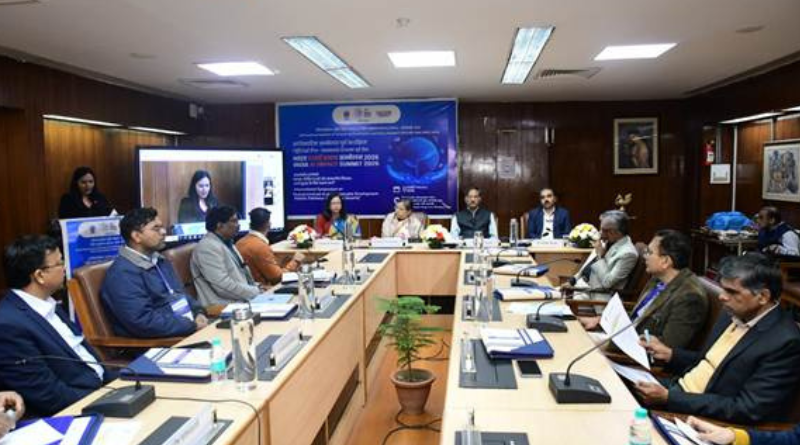
New Delhi, February 10, 2026: The CSIR—National Institute of Science Communication and Policy Research ICSIR-NIScPR) on Tuesday organized an International Symposium on “Human-centred AI and Sustainable Development: Holistic Pathways for Energy Security” at its Pusa campus.
The event was held as an official pre-summit program of the upcoming India-AI Impact Summit 2026.
The day-long symposium brought together leading experts from India and abroad to deliberate on people-centric, ethical, and inclusive artificial intelligence approaches to ensure sustainable and secure energy futures.
Inaugural session of CSIR-NIScPR:
Welcoming participants, Dr. Geetha Vani Rayasam, Director, CSIR-NIScPR, emphasized the importance of safe, trusted, and human-centred AI.
She said the symposium aims to generate concrete ideas and policy-relevant inputs to help the government shape AI frameworks aligned with sustainable development and energy security.
Chief Guest Dr. Ashutosh Sharma, Former President of INSA and Institute Chair Professor at IIT Kanpur, highlighted the “lights and shadows” of AI technologies, stressing that AI should function as an enabler rather than a replacement, expanding opportunities where traditional systems have fallen short.
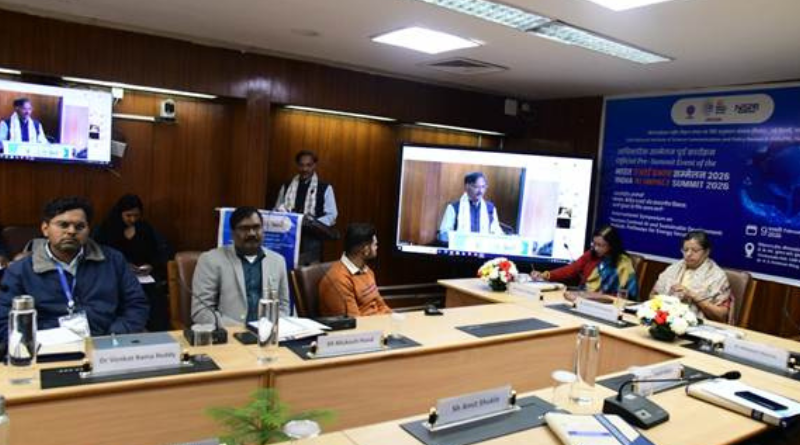
Dr. Nadia Asheulova of the Russian Academy of Science noted that India’s philosophical traditions provide a strong foundation for human-centred AI thinking.
She underlined that renewable energy transitions are social and institutional challenges, not merely technical ones, and stressed the need for democratization of intelligence.
Dr. Vivek Singh, Senior Advisor, NITI Aayog, said India has adopted a balanced AI approach that promotes innovation while protecting societal interests.
He highlighted the importance of India-centric data, reskilling, and upskilling to enable meaningful human-AI collaboration.
Keynote and technical sessions:
The keynote session, chaired by Prof. Indranil Manna (VC, BIT Mesra), explored AI-driven pathways to energy security.
Speakers, including Prof. Uday B. Desai, Dr. K. Ramesha (CSIR-CECRI), and Prof. Andrey V. Rezaev, discussed technology frontiers, systems-level challenges, and international collaboration.
The Technical Session on “AI: Equity, Integrity and Inclusivity,” chaired by Prof. Anirban Chakraborti (JNU), focused on responsible innovation, governance frameworks, and interdisciplinary research.
Speakers examined AI’s role in energy security, governance, open science, healthcare, and legal and IPR frameworks.
Technical Session II, chaired by Prof. Andrey V. Rezaev, addressed ethical dilemmas, energy transition challenges, and systemic risks.
Experts from IIT Delhi, CSIR-NIScPR, and international institutions discussed AI’s dual impact—its optimization potential and associated infrastructure and policy risks.
Panel discussion:
A high-level panel on “AI Pathways towards Energy Security—Opportunities and Challenges,” chaired by Dr. Akhilesh Gupta (INSA), highlighted the need for responsible AI deployment, cross-disciplinary research, and multi-stakeholder cooperation. Panellists agreed that AI-powered solutions, supported by strong research ecosystems and aligned policies, will be crucial for ensuring sustainable energy systems.
Valedictory session:
The symposium concluded with a summary of key insights by Dr. Kasturi Mandal, followed by concluding remarks from Dr. Geetha Vani Rayasam, reaffirming CSIR-NIScPR’s commitment to advancing human-centred AI and science-informed policymaking for sustainable development and energy security.
EOM.

Pingback: India AI Impact Summit & Expo 2026 begins in New Delhi; Bihar signs MoU worth Rs 468 crore.