CeNS researchers develop thermally stable gold-liquid crystal hybrid for next-gen optical technologies.
Photo Credit: PIB
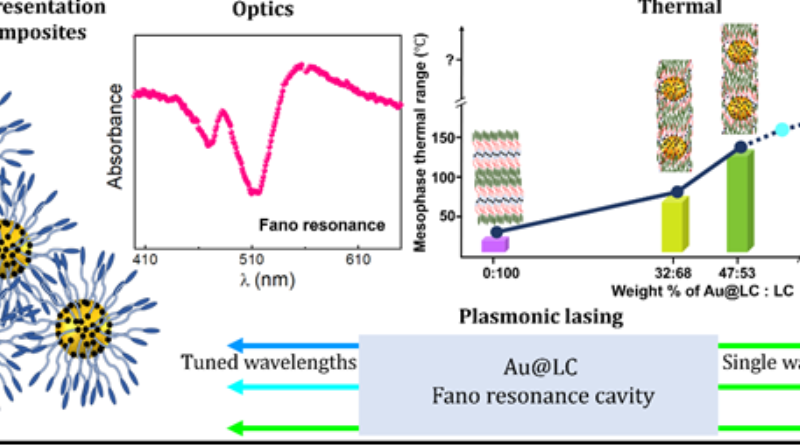
New Delhi, February 24, 2026: In a major advance in the Centre for Nano-Soft Materials Science (CeNS), researchers have developed a novel gold—liquid crystal (Au—LC) hybrid material that remains stable under extreme temperature fluctuations and exhibits enhanced optical properties.
The breakthrough could accelerate the development of next-generation optical technologies, energy-efficient electronics, and advanced sensing platforms.
CeNS hybrid materials represent a rapidly emerging frontier where the precision of nanotechnology merges with the adaptability of soft matter.
Such materials are increasingly in demand for cutting-edge electro-optical and photonic applications.
The research was carried out by a team from the Centre for Nano and Soft Matter Science (CeNS), Bengaluru, and an autonomous institute under the Department of Science and Technology (DST). The study was led by senior scientist Muskan Duggal, with key contributions from S. Krishna Prasad, D. S. Shankar Rao, C. V. Yelamaggad and Santosh Khatavi.
CeNS smart molecular design enables a breakthrough:
Using molecular engineering and minimal processing, the researchers achieved dramatic structural and functional transformations in the material.
The key innovation was the synthesis of an amine-functionalized liquid crystal, which simultaneously acted as a reducing agent for forming gold nanoparticles and stabilized them in situ, eliminating the need for additional chemical reagents.
This streamlined approach not only simplified the synthesis process but also provided unprecedented control over the hybrid structure—demonstrating how simple ligand engineering can unlock versatile and high-performance material systems.
Exceptional thermal and optical performance:
The Au—LC composite showed a remarkable enhancement in thermal stability, expanding the operational range from 27 degrees Celsius in pure liquid crystals to an impressive 145 degrees Celsius in the hybrid material.
Equally significant was the emergence of a rare optical phenomenon known as Fano-like resonance, an effect associated with strong light-matter interactions.
This feature holds immense promise for advanced light-based technologies, including Plasmonic lasers (speasers), ultra-compact, high-intensity light sources, Ultra-sensitive sensors capable of detecting trace chemicals, pollutants, or biological markers, engineered photonic materials for precise light manipulation, enabling high-performance optical filters and even invisibility-inspired cloaking devices.
These capabilities position the material at the forefront of nano-photonics, optics, and biomedical imaging research.
CeNS Towards scalable, real-world applications:
The distinctive optical behavior achieved through this relatively simple nano-soft hybrid design suggests a more accessible and cost-effective pathway to effects that previously required complex and expensive fabrication techniques.
The team’s findings, published in ACS Applied Nano Materials, highlight the potential of Au—LC hybrids as practical, scalable platforms for real-world applications—ranging from smart sensors and responsive coatings to next-generation photonic and optoelectronic devices.
Also Read: WAVES strengthening India’s global content creation ecosystem: Government.
EOM.