ADA’s two-day National Symposium “Aeronautics 2047’ begins in Bengaluru.
Photo Credit: PIB
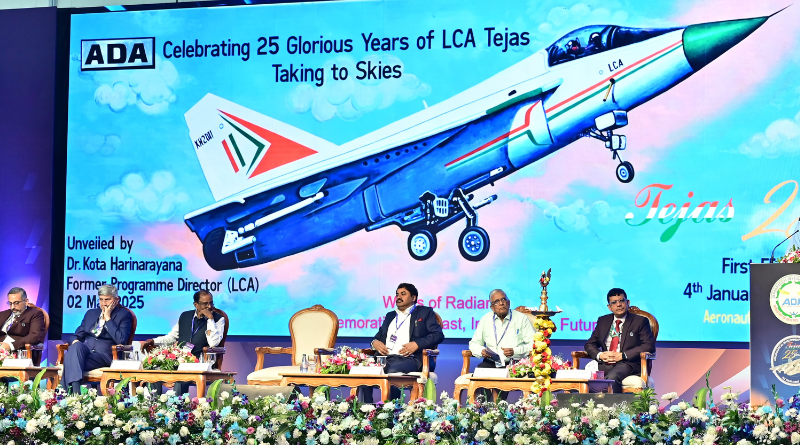
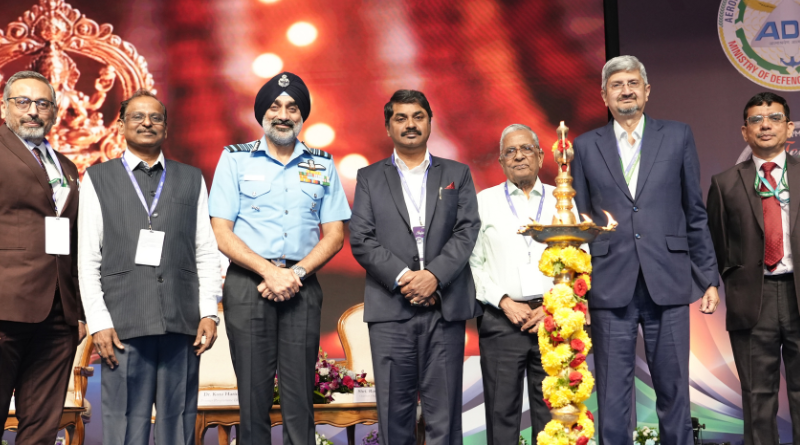
New Delhi, January 4, 2026: The two-day national symposium ‘Aeronautics 2047,’ organized by the Aeronautical Development Agency (ADA), commenced on January 4, 2026, at the Centre for Airborne Systems (CABS) in Bengaluru.
The symposium was inaugurated by the Chief of the Air Staff, Air Chief Marshal A. P. Singh.
Addressing the gathering, the Air Chief Marshal congratulated ADA on the completion of 25 years of the Light Combat Aircraft (LCA) Tejas program and underscored the importance of adhering to delivery timelines to ensure the operational readiness of the Indian Air Force (IAF) in an increasingly dynamic security environment.
Speaking on the occasion, Dr. Samir V. Kamat, Secretary, Department of Defence Research and Development and Chairman, DRDO, emphasized the need for indigenous development of cutting-edge technologies to reduce dependence on imports and realize the vision of a developed India by 2047.
Focus on future Aerospace technologies in the National Symposium on Aeronautics 2047:
The symposium brings together aerospace experts, industry partners, academicians, aviation leaders, and defence scientists to deliberate on the future of aeronautics.
The core objective of Aeronautics 2047 is to explore critical areas of modern aerospace technologies, including, Manufacturing and assembly of next-generation aircraft, Digital manufacturing and digital twin technologies, Advanced aerodynamic for future fighter aircraft, Propulsion technologies and flight testing techniques, Certification challenges, Flight control systems and avionics, Maintenance challenges in fighter aircraft, Application on artificial intelligence in aircraft design, Precision manufacturing for actuators.
The symposium will also deliberate on the future of Indian space technology and trace the Journey of the LCA Tejas from conceptual design to squadron induction.
LCA Tejas has completed over 5,600 successful flight tests. The program involved more than 100 design and development centres, including government laboratories, academic institutions and industry partners.
Several advanced technologies were indigenously developed, such as carbon composites, lightweight materials, fly-by-wire flight control systems, a digital utility management system, and a glass cockpit, making Tejas a fourth-generation fighter aircraft.
The LCA Mk1A, an advanced variant of the Tejas, will serve as a potent platform to meet the operational requirements of the Indian Air Force.
Development work is currently underway on the LCA Mk II and the LCA Navy variants. As part of the symposium, a series of technical presentations will be delivered by eminent experts associated with the Tejas program.
Strengthening India’s Defence Manufacturing Ecosystem:
The LCA program has significantly enhanced India’s capability to indigenously design and manufacture fighter aircraft, making it one of the country’s most successful defence initiatives.
So far, 38 aircraft—32 fighter variants and six trainer aircraft—have been inducted into two IAF squadrons, providing the force with a fighter aircraft possessing strong air superiority capabilities.
As part of the symposium, a wide range of Public Sector Undertakings (PSUs), Defense PSUs, private industries, and MSMEs are showcasing their indigenously designed and developed aerospace products, highlighting India’s growing self-reliance in defense and aerospace manufacturing.
Also Read: The Indigo flight stopped at Patna airport after fuel leakage in the left engine.
EOM.